
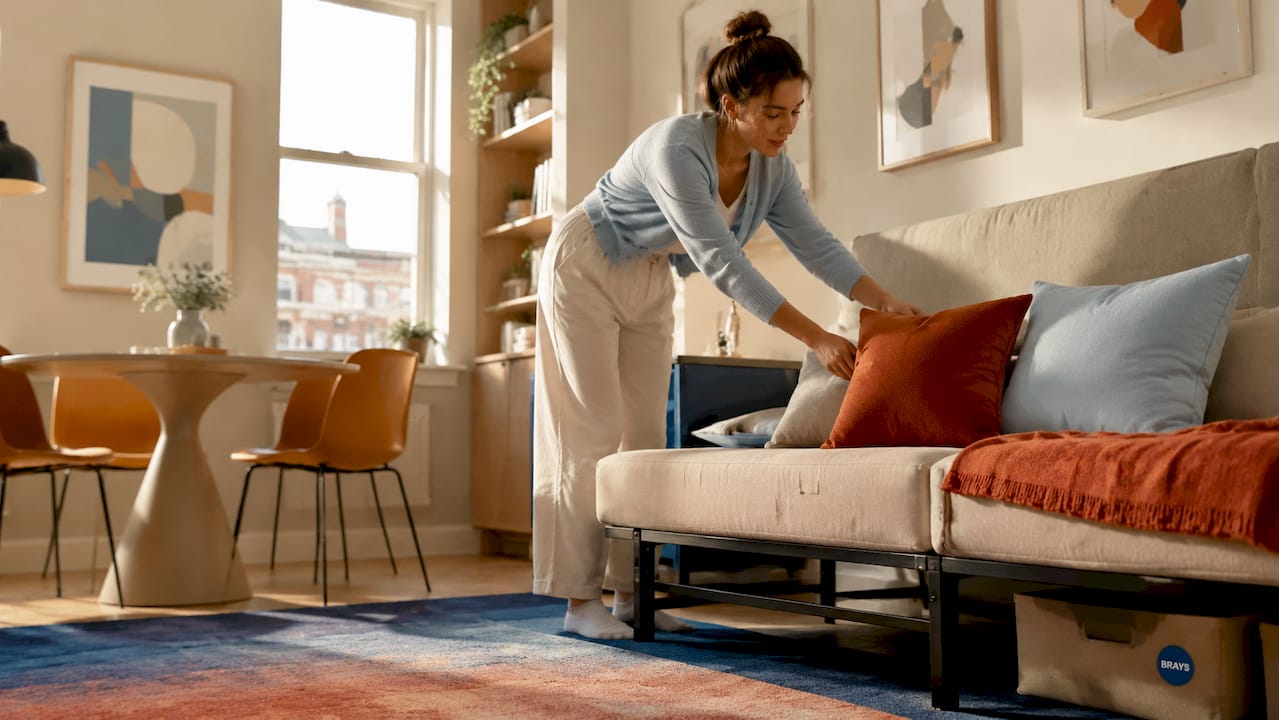
Multifunctional furniture is defined as any piece designed to perform two or more distinct roles, such as a storage ottoman that doubles as seating, a sofa bed that transforms a living room into a guest suite, or a wall-mounted desk that folds flush when not in use. The demand for these pieces is rising sharply as urbanisation and hybrid working reshape how people use their homes. For urban dwellers and students, the challenge is not simply saving space. It is doing so without surrendering the considered, personal aesthetic that makes a small room feel genuinely liveable.
What types of multifunctional furniture suit small spaces best?
The most effective way to style multifunctional furniture in a small space is to begin by understanding which furniture categories deliver the greatest return on floor area. Not all dual-purpose pieces are equal in terms of visual weight, practicality, or design quality.
Dual-purpose pieces such as ottomans and console-to-desk tables reduce the need for additional furniture entirely, which is the single most powerful principle in compact living. A storage ottoman, for instance, replaces a coffee table, a blanket box, and an occasional seat in one elegant form. An extendable dining table serves as a compact everyday surface and expands to accommodate guests without occupying permanent space.

Here is a comparison of the most popular multifunctional furniture types for small spaces:
| Furniture type | Primary function | Secondary function | Style consideration |
|---|---|---|---|
| Sofa bed | Seating | Guest sleeping | Choose slim arms and low profiles |
| Storage ottoman | Seating or footrest | Hidden storage | Upholstered finishes add warmth |
| Murphy bed | Sleeping | Wall unit or desk | Requires wall mounting assessment |
| Extendable table | Dining or working | Entertaining surface | Oval or round forms feel less imposing |
| Modular shelving | Storage | Room divider | Open shelving preserves visual flow |
| Convertible desk | Working | Decorative console | Wall-mounted versions free floor space |
Ottomans with hidden storage and extendable tables are particularly well suited to studio flats and student rooms because they address clutter and flexibility simultaneously. A sofa bed, meanwhile, is the defining piece for anyone who needs a living room and a bedroom to occupy the same footprint. BraysUK’s guide to sofa beds for real homes explores how to select convertible sofas that genuinely perform both roles without compromising on comfort or appearance.
Pro Tip: When selecting a sofa bed, prioritise models with a dedicated mattress depth of at least 10 cm rather than a fold-out cushion. The difference in sleep quality is considerable, and the piece will serve its secondary function as reliably as its primary one.
How to choose stylish multifunctional furniture that suits your aesthetic
Selecting pieces that are both functional and beautiful requires a deliberate approach to proportion, colour, and material. The most common mistake is choosing furniture that is too small in an attempt to save space. Slim-profile pieces at a comfortable scale create more cohesive, comfortable interiors than miniature alternatives that look out of place.
A cohesive colour scheme is the foundation of a well-styled small room. Neutral tones such as warm whites, soft greiges, and muted sage greens allow multifunctional pieces to recede visually, making the room feel larger and more considered. When every piece shares a tonal family, the eye reads the space as unified rather than cluttered.

Material choices carry equal weight. Light neutrals and glass or acrylic elements visually expand a room in a way that dark, heavy materials cannot. A glass-topped extendable table, an acrylic side chair, or open shelving with pale timber finishes all contribute to a sense of airiness. These are not merely aesthetic choices. They are spatial tools.
Consider the following principles when selecting pieces:
- Choose furniture with tapered or slender legs, which lift the visual weight off the floor and create breathing room beneath each piece.
- Opt for upholstery in performance fabrics that resist wear, since multifunctional pieces are used more intensively than single-purpose alternatives.
- Select modular or reconfigurable pieces where possible, as your needs in a student flat or rented apartment will change.
- Avoid ornate detailing on multifunctional furniture. Clean lines read as intentional and sophisticated in compact spaces.
Pro Tip: Before purchasing, photograph your existing room and use a free tool such as Roomstyler or Planner 5D to place scaled furniture digitally. This prevents the costly error of buying a piece that overwhelms the room proportionally.
For inspiration on how personalised home décor can complement a multifunctional furniture scheme, Wallfully’s guide to customisation offers practical ideas for layering personality into a space-conscious interior.
How to arrange multifunctional furniture in a compact living area
Arrangement is where the design principles above become tangible results. A well-chosen piece placed poorly will still make a small room feel cramped. The sequence below provides a reliable framework for planning your layout.
- Measure precisely. Record the room’s dimensions including door swings, window sill depths, and radiator positions. Poor dimension measurements are the leading cause of costly furniture returns and layout failures in small spaces.
- Identify your vertical plane. Walls are underused in most small rooms. Murphy beds and wall-mounted desks can free 30 to 50% of floor area compared to their freestanding equivalents. This is the single most impactful spatial decision you can make.
- Anchor the room with one primary piece. In a studio flat, this is typically the sofa or the bed. All other multifunctional pieces should relate to this anchor in scale and tone.
- Place furniture around the perimeter. Keeping the central floor area clear creates the impression of a larger room and allows multifunctional pieces to be used without obstruction.
- Layer lighting deliberately. A well-lit room reads as larger. Use a combination of ceiling, task, and ambient lighting to define zones within a single open-plan space.
The table below illustrates how different room types benefit from specific multifunctional furniture arrangements:
| Room type | Recommended anchor piece | Key vertical solution |
|---|---|---|
| Studio flat | Sofa bed | Wall-mounted shelving unit |
| Student bedroom | Storage bed frame | Fold-down wall desk |
| Shared living room | Modular sofa with storage | Tall bookcase as room divider |
| Compact kitchen-diner | Extendable dining table | Wall-mounted spice and utensil rack |
Pro Tip: Install wall-mounted furniture only after confirming your wall type. Stud walls, plasterboard, and solid masonry each require different fixings. Wall-mounted furniture demands walls rated for the relevant weight load. A structural failure is both dangerous and expensive.
Common challenges when styling multifunctional furniture for small spaces
Even well-intentioned small-space schemes encounter predictable problems. Recognising these in advance saves both money and frustration.
The most frequent errors include:
- Ignoring vertical space. Most people furnish only the lower two metres of a room. Shelving, wall desks, and overhead storage cabinets reclaim otherwise wasted area.
- Choosing oversized or visually heavy pieces. A bulky sectional sofa in a 20-square-metre flat will dominate the room regardless of how many functions it performs. Scale matters as much as versatility.
- Failing to account for clearance zones. A Murphy bed requires clear floor space in front of it when open. An extendable table needs room on both ends. Measure the piece in its fully extended or deployed state, not just its resting dimensions.
- Introducing too many pieces at once. A flexible, stylish environment is built gradually. Adding one well-chosen multifunctional piece at a time allows you to assess its impact before committing further.
“The most liveable small spaces are not the most cleverly packed. They are the most deliberately edited.”
For those adapting a space to accommodate hybrid working, a convertible desk or a sofa with an integrated side table provides a defined work zone that can be visually closed off at the end of the day, preserving the psychological separation between work and rest.
Key takeaways
Stylish multifunctional furniture transforms small spaces when pieces are chosen for slim profiles, cohesive colour, and genuine dual-function performance rather than novelty alone.
| Point | Details |
|---|---|
| Define function first | Identify the two roles each piece must perform before selecting it. |
| Prioritise vertical space | Wall-mounted and fold-away furniture frees significant floor area in compact rooms. |
| Choose slim, scaled pieces | Correctly proportioned furniture with tapered legs reads as lighter and more refined. |
| Build gradually | Introduce one multifunctional piece at a time to assess spatial and aesthetic impact. |
| Invest in quality | Durable, well-made dual-function pieces adapt as lifestyle needs change and offer lasting value. |
Living intentionally: a perspective on small-space furniture
The conversation around small-space living has shifted considerably. Where it once centred on compromise, it now centres on intention. The most satisfying compact interiors I have encountered are not those that cram in the maximum number of functions. They are the ones where every piece has been chosen with genuine care for how it will be used, how it will look, and how it will feel to live alongside it day after day.
There is a tendency to treat multifunctional furniture as a purely practical category, something you buy because you have no choice. That framing misses the point entirely. A beautifully upholstered storage ottoman or a thoughtfully designed sofa bed is not a concession to limited square footage. It is a considered investment in a space that works as hard as you do. The adaptability of quality pieces means they remain relevant as your life changes, whether you move from a student room to a first flat or reconfigure a home office after a job change.
The advice I return to most often is this: buy fewer pieces, but buy them better. A single well-made sofa bed from a brand that understands both comfort and design will serve you more faithfully than three budget alternatives that each do one thing adequately. Style and function are not in opposition in a small space. They are the same decision.
— V
Discover stylish multifunctional furniture at BraysUK
BraysUK curates furniture collections designed specifically for the realities of modern urban living, where every square metre must earn its place without sacrificing the elegance you deserve.

Whether you are furnishing a studio flat, a student room, or a compact city apartment, BraysUK’s range combines contemporary design with genuine everyday functionality. Explore the affordable luxury furniture guide to discover how premium-looking pieces can be accessible without compromising on craftsmanship or durability. For those prioritising versatility, the collection of convertible sofas and beds offers solutions that perform beautifully in both their roles. Thoughtful furniture is not a luxury reserved for large homes. BraysUK makes it attainable for every space.
FAQ
What is multifunctional furniture?
Multifunctional furniture is any piece designed to serve two or more distinct purposes, such as a sofa bed, storage ottoman, or fold-down wall desk. These pieces reduce the total number of items needed in a small room while maintaining full functionality.
Which multifunctional furniture type is best for a studio flat?
A sofa bed is the most impactful single piece for a studio flat, as it combines the primary living and sleeping functions in one footprint. Pairing it with a storage ottoman and a wall-mounted shelf maximises both storage and floor area.
How do I stop multifunctional furniture from making a small room look cluttered?
Choose pieces with slim profiles, tapered legs, and neutral upholstery, and introduce them one at a time. Slim, unobtrusive designs preserve visual cohesion and prevent the room from feeling overloaded.
Is wall-mounted furniture safe in rented flats?
Wall-mounted furniture is safe when installed correctly into load-bearing fixings appropriate for your wall type. Always confirm the wall’s construction and weight rating before mounting a Murphy bed or floating desk, as poor installation is the primary cause of structural failures.
How much should I spend on multifunctional furniture for a small space?
Prioritise quality over quantity. One well-made, durable piece that performs both its functions reliably will outlast and outperform several cheaper alternatives, and it will adapt more gracefully as your living situation evolves.
One Reply to “Style multifunctional furniture for small spaces”